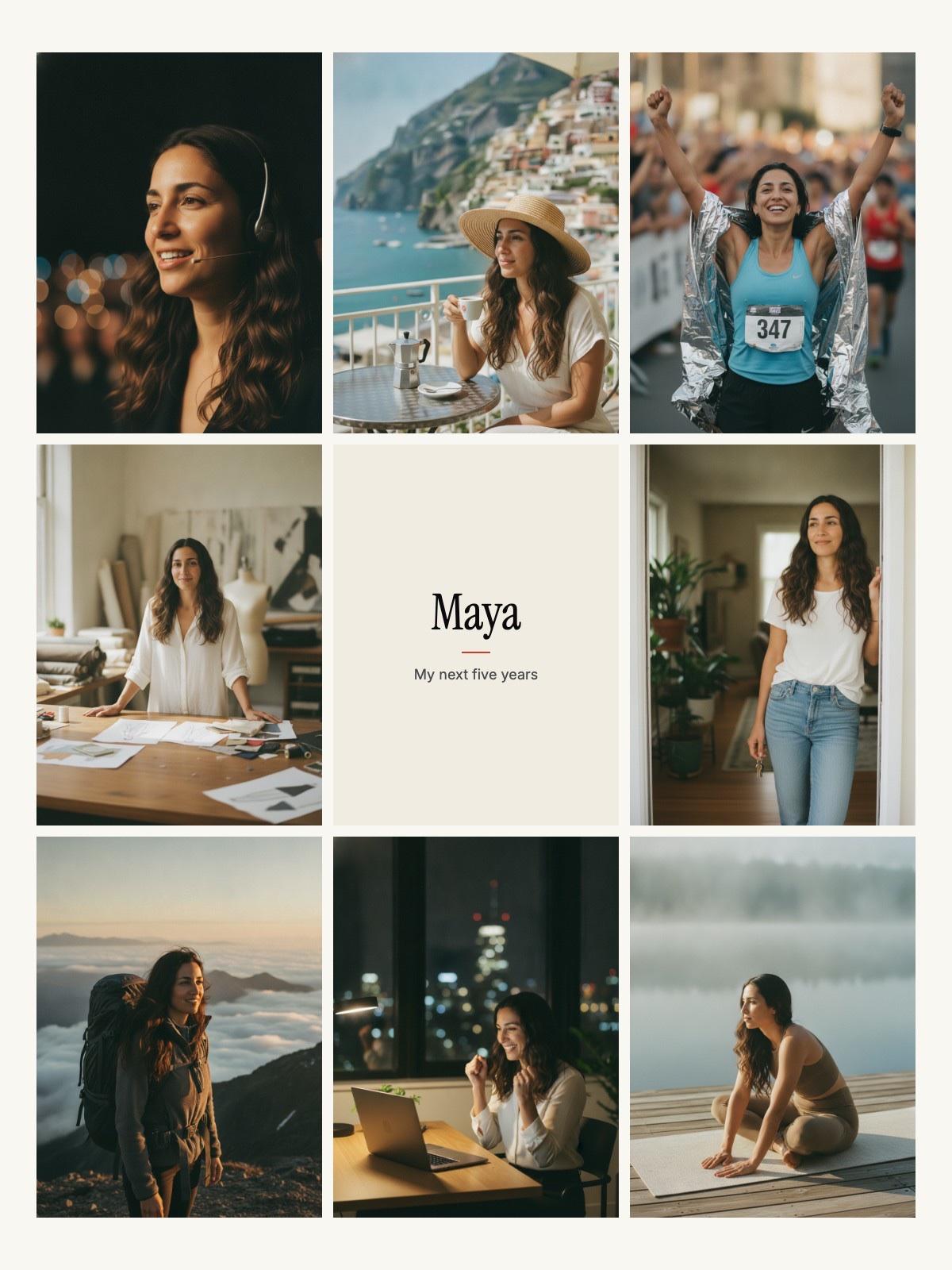
The WOOP Method, With a Vision Board That Shows the Obstacle
Wish, Outcome, Obstacle, Plan, on one board you see every day.

WOOP is a four-step goal method: Wish, Outcome, Obstacle, Plan. It is the everyday name for mental contrasting with implementation intentions (MCII), which grew out of psychologist Gabriele Oettingen's research on mental contrasting and Peter Gollwitzer's work on if-then plans. You name a wish, picture the best outcome, name what holds you back, and write one plan: "If [obstacle], then I will [action]."
A vision board covers the first two letters. WOOP adds the two a board leaves out. This guide walks through the four steps, then shows how to put all four on one board you look at every day.
What WOOP stands for
Wish
Pick one wish that matters to you and that you believe you can reach. Write it in a few words: "Run a half marathon in 2027."
Outcome
Picture the single best result of getting there, as a moment you are in: where you are, who is with you, how it feels. Stay with it for a while.
Obstacle
Now name what in your life right now holds you back. Look for one of your own: a habit, a feeling, an excuse. For the run, it might be "I hit snooze when it is dark and cold."
Plan
Write one if-then sentence that answers the obstacle: "If the alarm goes off and I want to snooze, then I will put my feet on the floor and put on the shoes I left by the bed."
Why a vision board alone covers only half of it
A vision board is a Wish and an Outcome you can see. That is a good start, and it is also where the research gives a warning. In four experiments published in 2011 in the Journal of Experimental Social Psychology, Heather Barry Kappes and Gabriele Oettingen found that positive fantasies about an ideal future led to lower energy than other ways of thinking about that future, such as questioning it. The drop was larger when the need behind the wish was more pressing.
If you have ever almost written a fresh list of 10 for the new year, and remembered that last time, by March, two were alive, the pictures were not the problem. The missing part was the obstacle and the plan. "I start strong, then life happens" is the Obstacle step in plain words. WOOP asks you to give "life happens" a name and an if-then answer before it shows up.
The short version
The board shows where you are going. WOOP adds what will get in the way, and what you will do when it does.
How to make a WOOP vision board
Pick three or four wishes for the year, not ten. If you usually pick five or six at once and drop all of them by February, start smaller: a short board is one you can keep a plan for. Each wish gets three things on the board: a scene of you in the outcome, one obstacle line, and one if-then line.
Write the WOOPs first
One per wish, on paper or in a note on your phone. Keep the obstacle and the plan to one line each.
Make the Outcome a picture of you
One scene per wish that shows the best result as a moment you are in: crossing the line, holding the keys, the table on a Sunday night.
Put the obstacle and the plan under the picture
Two short lines under each scene. The obstacle in your own words, then "If ..., then I will ...". This is the part most boards skip.
Make it your lock screen
A board you see every time you pick up your phone keeps the plan in front of you, not only the picture.
| Wish | Outcome (the scene) | Obstacle | If-then plan |
|---|---|---|---|
| Run a half marathon | You at the finish line, medal on | I skip runs when it is dark and cold | If it is dark and I want to skip, then I will go out for 15 minutes anyway |
| Save for a deposit | You holding the keys to your own place | I order takeout when I am tired after work | If I open a delivery app after work, then I will move what the order would cost to savings and cook something simple |
| A weekly dinner with your partner | The two of you at the table, phones away | We both say we are busy and push it to next week | If one of us says "next week", then we will pick the night before we end the conversation |
| Change careers | You on your first day in the new role | I put off applying because I feel I am not ready | If I think "I am not ready yet", then I will send one application that day |
Not sure yet what your wishes are? The writing exercise in /blog/best-possible-self-exercise helps you find them before you choose any pictures, and /blog/vision-board-2027-ideas has scene ideas for each area of life.
What the research shows, and what it does not
In a 2021 meta-analysis in Frontiers in Psychology, Guoxia Wang, Yi Wang and Xiaosong Gai pooled studies of MCII. It helped people reach their goals, with an effect the authors call small to medium. The effect was larger when people went through it with an experimenter than when they completed an intervention package online, at home or in the classroom. The authors also found signs of publication bias, so the real effect may be smaller.
The if-then part has its own evidence. Gollwitzer described implementation intentions in American Psychologist. A 2006 meta-analysis by Gollwitzer and Sheeran, based on close to a hundred studies, found a medium to large effect on reaching goals. Oettingen and colleagues, writing in 2015, describe a study in which MCII helped college students break snacking habits more than either half of the method on its own.
We found no study that has tested a WOOP vision board. The research is about the thinking and the plan, not about pictures. So the honest claim is narrow: the board keeps the wish in view, and the obstacle and if-then lines carry the part the research supports.
Say it to someone
In the meta-analysis, MCII done with an experimenter had a larger effect than MCII completed from a package online, at home or in class. That person was a researcher, not a friend, so this is not proof that a friend helps, but it costs nothing to try: say your WOOPs out loud to someone before you put them on the board.
When to do it
Now, before January, while the year is still a plan. Then once a week, read your if-then lines and ask two questions: did the obstacle show up, and did you do what the plan said? If the obstacle has changed, write a new line. That weekly check is what keeps the board useful after the first few weeks, when it is easy to stop looking.
Related: why resolutions fade, and what a one-year trial found, in /blog/why-new-years-resolutions-fail.
A WOOP board with you in the scenes
The Outcome step is easier to feel when the picture is of you, not a stranger. On FutureSelf you upload one photo and get eight scenes with your own face in them, laid out as one board for your phone. Then write the obstacle and the if-then line for each scene next to it. The first scene is free and the board is $4.90 once. Nothing renews, so there is nothing to cancel in February. See your first scene at /vision-board-2027
Frequently asked questions
helpWhat does WOOP stand for?
Wish, Outcome, Obstacle, Plan. In research it is called mental contrasting with implementation intentions, or MCII.
helpWho created the WOOP method?
It comes from psychologist Gabriele Oettingen's research on mental contrasting, combined with Peter Gollwitzer's research on if-then plans, which he called implementation intentions.
helpIs WOOP the same as a vision board?
No. A vision board shows the wish and the outcome. WOOP adds the obstacle and an if-then plan. You can put all four on one board: the scene, then one obstacle line and one plan line under it.
helpWOOP vs SMART goals: what is the difference?
SMART is a checklist for how a goal is written: specific, measurable, achievable, relevant, time-bound. WOOP is a short thinking routine about what will get in the way and what you will do then. They fit together: a SMART goal can be your Wish.
helpDoes the WOOP method work?
A 2021 meta-analysis found a small to medium effect on reaching goals, larger when done with an experimenter than from a package online, at home or in class. The authors note that publication bias may mean the true effect is smaller.
helpCan I use WOOP for New Year's resolutions?
Yes. Do one WOOP per resolution, keep it to three or four, and write the if-then plans before January starts. Then check them once a week.