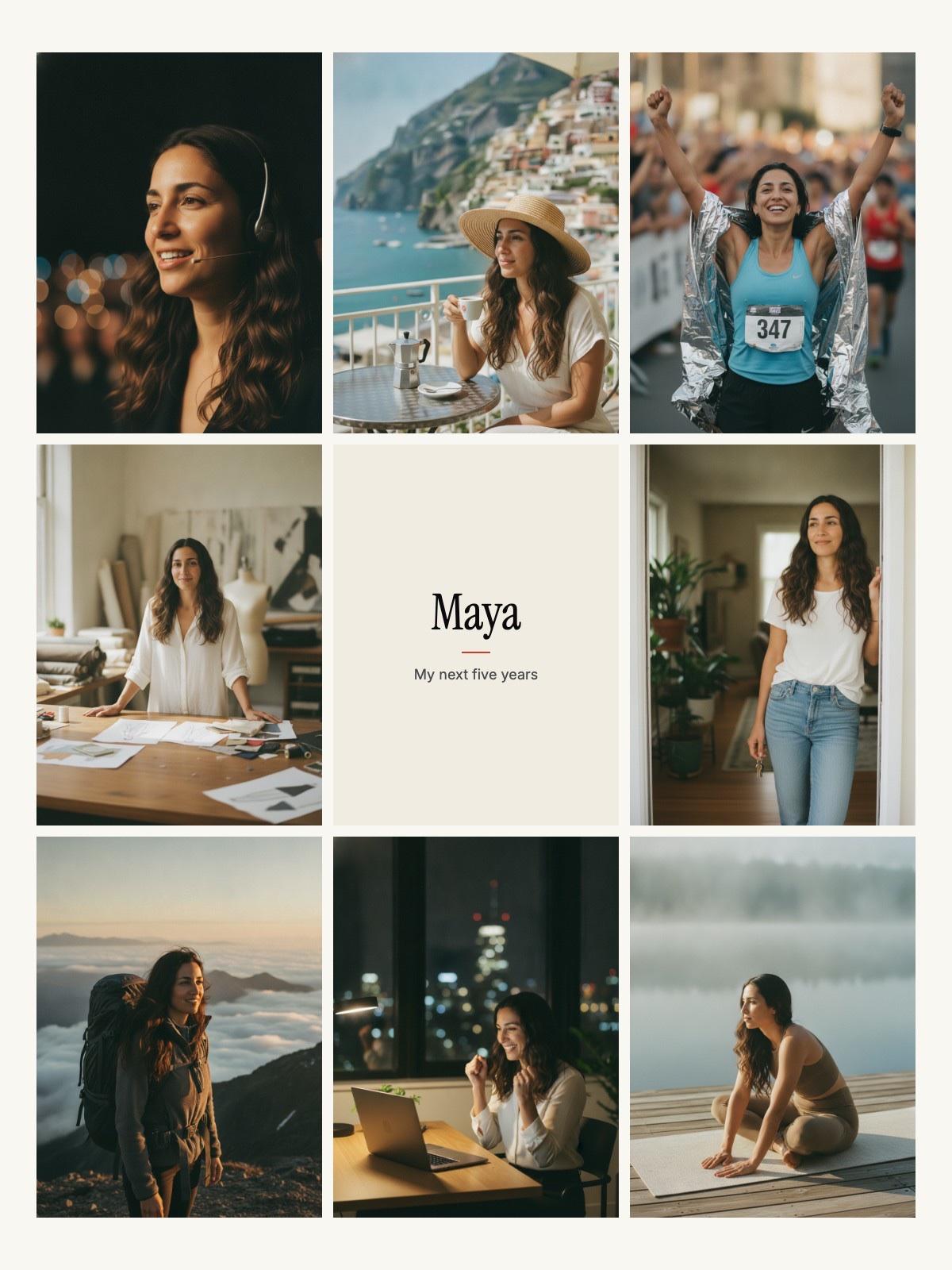
The Anti-Vision Board: Name the Life You Refuse, Then Picture the One You Want
Start with what you refuse. End with a scene and one step for this week.

An anti-vision board is a written picture of the life you refuse to drift into: what an ordinary day looks like if nothing changes. It is useful when you feel stuck and cannot yet say what you want. Write it once, then turn each line into a scene you want and one step for this week.
Where the idea comes from
The term appears in Dan Koe's essay "How to fix your entire life in 1 day," published in December 2025. He describes an anti-vision as "a brutal awareness of the life you do not want to live" and asks readers to describe an average Tuesday five years from now if absolutely nothing changes.
People are still using it as they plan the next year. In November 2026, the writer Mickey Fisher, who credits Koe's essay, described using his own version at a stoplight while choosing between the gym and a writing session, by picturing "the bad version of my life a year from now." The gym won.
The appeal is easy to understand. If your life does not budge an inch towards what you want, it can be easier to say what you refuse than what you hope for.
How to make an anti-vision board
Write a normal day, one year from now
Assume nothing changes: same job, same habits, same excuses. Start when the alarm goes off and stop when you go to bed. Write what you do, who you see and how you feel at 4 pm.
Pick the three lines that burn
Read it back and choose the three lines you would most hate to be living. Three gives you something you can work on this week.
Mark what is already happening
Put a dot next to anything that is already true today. Those lines are where you start, because you can change them now.
Do the Flip
Turn each of the three lines into a scene you want and one first step. The table below shows how.
The Flip: four anti-vision board examples
The Flip is our name for the last step. Each row starts with something you refuse and ends with something you can do by Sunday.
| I refuse | What it looks like on a normal Tuesday | The scene I want instead | First step this week |
|---|---|---|---|
| Work: another year in a job I stopped caring about | I open the laptop at 9, count the hours by 11 and say "it's fine" when anyone asks | Leading a project in the field I keep reading about | Message one person who does that work and ask for a short call |
| Money: still not knowing where my pay goes | I check my balance the day before rent and hope | At my kitchen table on payday, moving money into savings first | List every subscription and cancel one |
| Health: getting winded on the stairs | I take the elevator one floor and promise to start on Monday | Walking up the hill near home on a Saturday morning, still talking | Walk for 15 minutes on Tuesday and again on Thursday |
| Relationships: becoming a stranger to the people I love | We eat in the same room with our phones out and talk about logistics | Sunday dinner at our table, phones in another room | Text one person today and set a date |
Write the third column as something a camera could catch. "More freedom" gives you nothing to look at. "Lunch outside on a Wednesday because my schedule is mine" does.
Why you should not stop at the list
A list of what you refuse says what to move away from, and it gives you nothing to do on a hard morning. A one-year experiment on New Year's resolutions shows why that matters. Oscarsson and colleagues (PLOS ONE, 2020) enrolled more than a thousand Swedish-speaking adults. After a year, more than half of the people whose main resolution was an approach goal, moving toward something, rated themselves successful. Among people with an avoidance goal, avoiding something, fewer than half did. Not everyone in the study was part of that comparison, and success meant giving yourself a high score on the study's own scale.
The researchers describe the difference as a small effect, the ratings were people's own, and the comparison does not prove that wording alone made the difference. It is still a good reason to finish with something you want.
The second piece is the comparison itself. In four experiments, Oettingen, Pak and Schnetter (Journal of Personality and Social Psychology, 2001) found that people who only fantasized about a desired future, or only reflected on present reality, formed moderate commitment to the goal whatever their chances looked like. People who contrasted the two formed strong commitment when they expected to succeed and weak commitment when they did not.
So if picturing the life you want makes you sad that you are not there yet, you have already found the gap this research works with. Put the scene next to today and ask whether you believe you can get there. If the answer is no, choose a nearer scene.
A beautiful picture on its own is no answer either. In four experiments, Kappes and Oettingen (Journal of Experimental Social Psychology, 2011) found that induced positive fantasies left people with less energy than fantasies that questioned the desired future, negative fantasies or neutral ones. That is why every row of the Flip ends in a step.
What this research does not show
None of these studies tested an anti-vision board. They looked at how goals were worded, at contrasting a wanted future with today, and at positive fantasies. The Flip is our way of putting those findings to work.
Where each one goes
Keep the refusal list in a notebook and open it when you are planning or when you notice yourself drifting. Put the scene where you look all day. On your lock screen it stays in front of your eyes on every unlock. This split is our advice: what you see most often should show where you are heading.

Stuck on what you want?
If you are feeling stuck in your career or stuck in a rut, the third column can be the hardest one to fill. Write a full version of the future with /blog/best-possible-self-exercise, take one question at a time from /blog/future-self-journaling-prompts, or rate eight areas of your life with /tools/wheel-of-life and begin with the lowest.
Thinking about making a change at work but torn between two directions? Fill in the work row twice, once for each, and see which scene you keep coming back to.
See the scene with your face in it
Try on the next chapter before you jump. Take the strongest line from your third column and pick the closest goal at /vision-board-for. You upload one selfie and see your first scene free. The full board of eight scenes is $4.90 once, and nothing renews. It keeps the life you want in front of your eyes, and the first step stays yours.
Frequently asked questions
helpWhat is an anti-vision board?
A written description of the life you refuse to drift into, usually an ordinary day if nothing changes. People use it to get unstuck before they can say what they want.
helpWhat do you put on an anti-vision board?
Specific lines about an ordinary day in your work, money, health and relationships. "Eating lunch at my desk, dreading the 2 pm call" tells you more than "being unhappy." Words are enough. If you want an actual board, keep it on a page you open on purpose.
helpIs an anti-vision board better than a vision board?
They do different jobs. An anti-vision shows what you want to leave, and a vision board shows where you want to go. In a one-year study of New Year's resolutions, people with approach goals were more likely to rate themselves successful than people with avoidance goals, so finish on what you want.
helpShould I look at my anti-vision every day?
We suggest you do not. This is our advice, not a research finding. Read it when you plan, and keep the scene you want in daily view. If writing it leaves you feeling low, put it down and talk to someone you trust.
helpDoes an anti-vision work?
We could not find a study that tested one directly, so we cannot give you a success rate. It can help you name what you want to change. The related research favors ending with a goal you move toward, compared honestly with today, and a first step you can take.