Can't Visualize? Aphantasia, Manifestation and Vision Boards
You do not need a mind's eye to look at a picture.

Aphantasia means the pictures in your mind's eye are missing or very faint. In a 2022 study of more than a thousand people, Dance, Ipser and Simner call it a rare trait and found it in a small share of both groups they screened. If that is you, you can still use a vision board, because a board is a picture outside your head. You look at it with your eyes open. Nothing has to appear when you close them.
Why guided visualization can feel like a test you fail
Most visualization exercises start the same way. Close your eyes. Picture your future self. Notice the room around you. If nothing shows up, the exercise has nowhere to go, and it is easy to decide that future self work and manifestation are for other people.
Plenty of people find this practice hard even with vivid imagery. Some say that imagining their future self makes them sad that they are not there yet. With aphantasia there is an earlier wall: you cannot get to the picture in the first place.
If your imagery is weak but not gone, a script read slowly can still help, especially if you let the answers come as words or feelings rather than images. Our future self visualization script at /future-self-visualization-script says the answers may come as words, a picture or a feeling. If you see nothing at all, skip to the next part.
What the future self research actually asked people to do
Here is the part most guides leave out. Two of the best-known studies people cite when they talk about how to meet your future self gave people something outside their head to work with: a picture or a page. In a 2011 paper in the Journal of Marketing Research, Hal Hershfield and colleagues had participants interact with realistic computer renderings of their own faces, aged, using immersive virtual reality and interactive decision aids. Across four studies, the people who met their aged self were more likely to accept money later over money now. The picture was made for them. They did not have to imagine it.
The best-known writing study showed people no picture at all. In Laura King's 2001 study in Personality and Social Psychology Bulletin, undergraduates wrote for a set time each day on four days in a row. Those who wrote about their best possible future self found it less upsetting than writing about trauma, and their well-being went up. Participants were asked to imagine their best future, and what they produced was words on a page.
The short version
These studies used two routes to the future self: a computer-made picture of your own aged face, and a page of writing. Neither asks you to see anything with your eyes closed.
What to do instead of closing your eyes
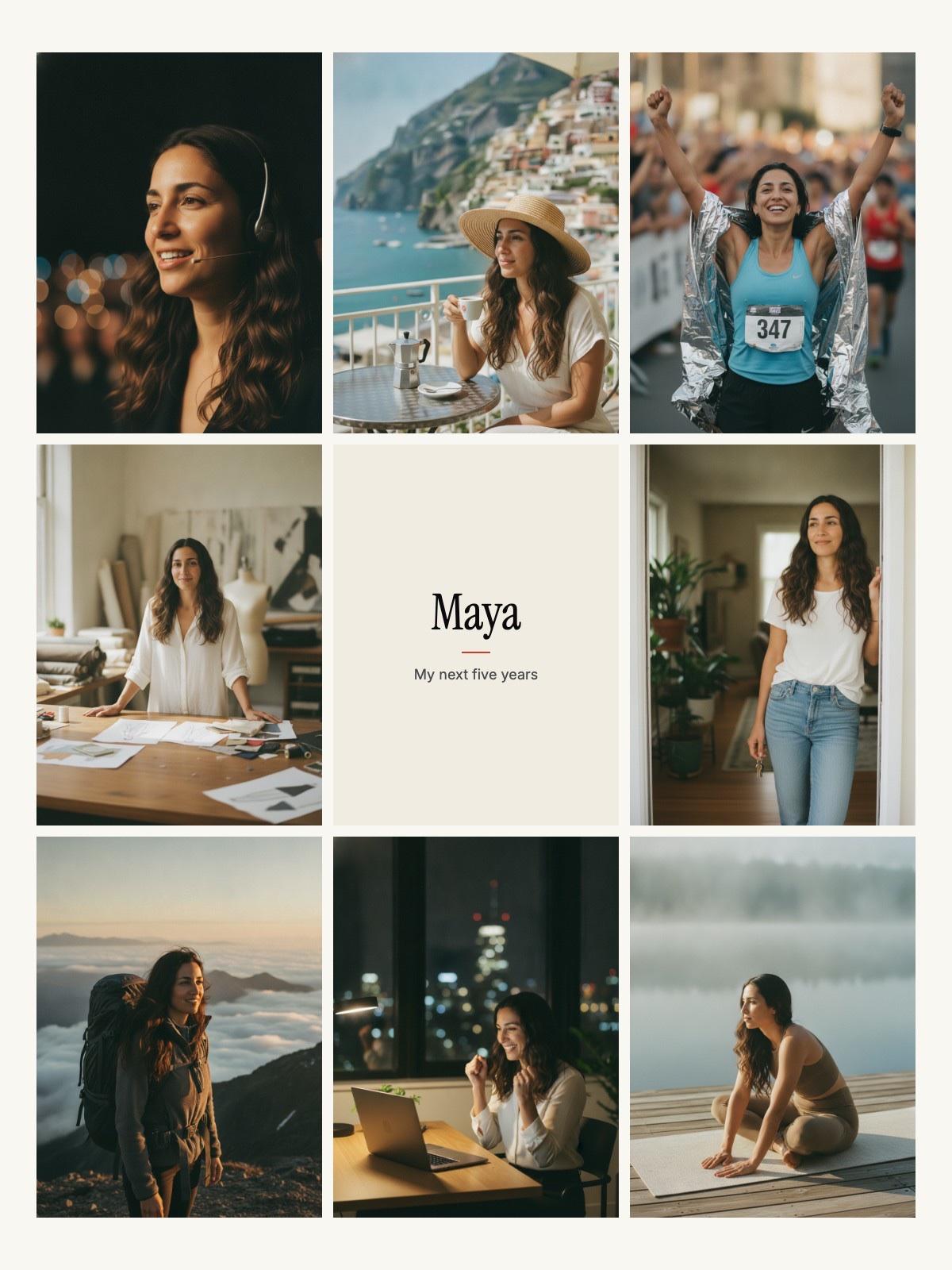
See it outside your head
Use a scene with your own face in it, not a stranger from a stock photo.
Write it
Describe one ordinary day in that life, in full sentences: where you wake up, who is there, what you finally finished. Specific beats pretty.
Put it where you already look
Lock screen, laptop wallpaper, the wall by your desk. You see it many times a day without having to make it.
Pick one step a week
Under each picture, one action you can do in the next seven days. The picture points the direction; the step moves you.
For the writing step, /blog/best-possible-self-exercise walks you through it with a timer and three examples. If you would rather answer one question at a time, our future self journaling prompts at /blog/future-self-journaling-prompts are sorted for one, five and ten years ahead.
What we do not know
We found no study that has tested vision boards in people with aphantasia, so nobody can honestly tell you a board works better or worse for you than for anyone else. Nothing on this page or in our app diagnoses aphantasia, changes it or tries to. The narrower point holds: the two routes the research used, a picture you look at and words you write, do not ask you to see anything with your eyes closed.
See your future self from one photo
Stop straining to picture your future self. On /see-your-future-self you upload one selfie and see yourself in the future scene, with your own face, living it. The first scene is free; the full board of eight scenes is $4.90 once, with nothing that renews. Set it as your lock screen and the picture is there every time you pick up your phone.
Frequently asked questions
helpCan you manifest with aphantasia?
Manifestation practices, like a law of attraction vision board, usually ask for a picture and a feeling. You can bring the picture from outside, as a photo or a scene of you, and the words by writing them down. No research shows that any manifestation practice makes a future happen on its own, so pair the picture with one step a week.
helpDo vision boards work if you can't visualize?
A vision board is already outside your head, so you do not need a mind's eye to use one. No study we found has tested vision boards in people with aphantasia specifically.
helpCan you do guided meditation with aphantasia?
Yes. Meditations that ask you to picture a beach or a light can be frustrating, but many practices, such as following the breath or noticing sensations in the body, do not ask for images at all. When a script says "see", you can describe the scene to yourself in words instead.
helpHow do I know if I have aphantasia?
Researchers often measure it with the Vividness of Visual Imagery Questionnaire (VVIQ), which asks you to rate how vivid imagined scenes are. A score on it is a research measure, not a diagnosis, and this page does not diagnose anyone.
helpIs aphantasia rare?
It is uncommon. Dance, Ipser and Simner (2022) screened university students and adults recruited online, more than a thousand people in all, and found it in a small share of each group.