Future Self Journaling Prompts: Questions for 1, 5 and 10 Years Ahead
Five minutes of writing as the person you are becoming.
Future self journaling means writing a few lines each day as, or to, the person you want to be in one, five or ten years. You pick one prompt, write for about five minutes in plain words, and end with one small thing you can do today. The prompts below are grouped by how far ahead you are looking and by life area, and each group ends with one question: what would the picture of this look like?
How to do it in five minutes
Pick one timeframe
One year, five years or ten years. Stay with the same one for a week so the entries build on each other.
Answer one prompt
Write in the first person and in detail: a place, a time of day, who is there. Detail is what makes the future you feel like you.
Describe the picture
Write one sentence that describes a single scene from the entry, as if it were a photo. That sentence is what you come back to.
Write today's step
Close with one action small enough to do before tonight. The entry points the direction; the step moves you.
Prompts for one year from now
One year is close enough to plan for and far enough to change something real. Use these when you want the next twelve months to look different from the last twelve.
sparklesOne year ahead
Prompts for five years from now
Five years is long enough for a different job, a different city or a different body. Write as the person who already lives there, not as someone hoping to.
sparklesFive years ahead
Prompts for ten years from now
Ten years out, plans get vague. These prompts keep it personal by asking about values, people and the shape of your days rather than exact titles or numbers.
sparklesTen years ahead
Prompts by life area
If one area of life is the reason you are journaling, stay there. Two prompts per area, plus the picture question at the end.
sparklesBy life area
Prompts for days when nothing comes
sparklesWhen you are stuck
An example entry
A written example of the format, using the five-year timeframe. Prompt: What does a normal Tuesday look like for me? Entry: I wake up at seven without an alarm. I walk to the studio I rent two streets from home, and the first hour is for my own project before any messages. At lunch I eat outside with a friend from the building. I leave at five because the work fits in the day now. The picture: me at the big table by the studio window, coffee on the left, the sketchbook open. Today's step: block 7:30 to 8:30 tomorrow for my own project and turn the phone off.

Why writing about your future self can help
Research on future self-continuity looks at how connected people feel to the person they will become. In a 2011 review in the Annals of the New York Academy of Sciences, Hal Hershfield describes three things that make people more willing to make choices today that help them later: when the future self feels similar to the present self, when it is pictured in vivid and realistic terms, and when it is seen in a positive light. A journal entry with a place, a time of day and a scene works on the second one, vividness.
The effect fades. In a 2026 randomized trial with 321 first-year university students (van Gelder and colleagues, Journal of Medical Internet Research), three weeks of meeting their future self in a phone app or in virtual reality made that future self feel more vivid and closer, and six months later part of that gain had worn off. That is the case for a habit you come back to.
What it is and what it is not
Future self journaling is a writing habit that keeps a direction in view. It does not make a future happen by itself, and it is not therapy. Pair each entry with one step you can take today.
Journal, letter or vision board: which one when
Future self journal
A few lines often, a daily or weekly habit. Best when you want to keep thinking as the person you are becoming.
Letter to your future self
One longer piece you write once and open later, in one, three or five years. Best for a milestone such as a birthday or a new year.
Vision board
Pictures you look at every day. Best when the words are clear and you want the scene in front of you without rereading.
For the one-time version, /letter-to-your-future-self has a template, prompts and examples for a letter you open years from now, and the free tool at /tools/future-letter lets you write and schedule one. For a single, longer writing exercise backed by research, see /blog/best-possible-self-exercise.
Turn one entry into a picture of you
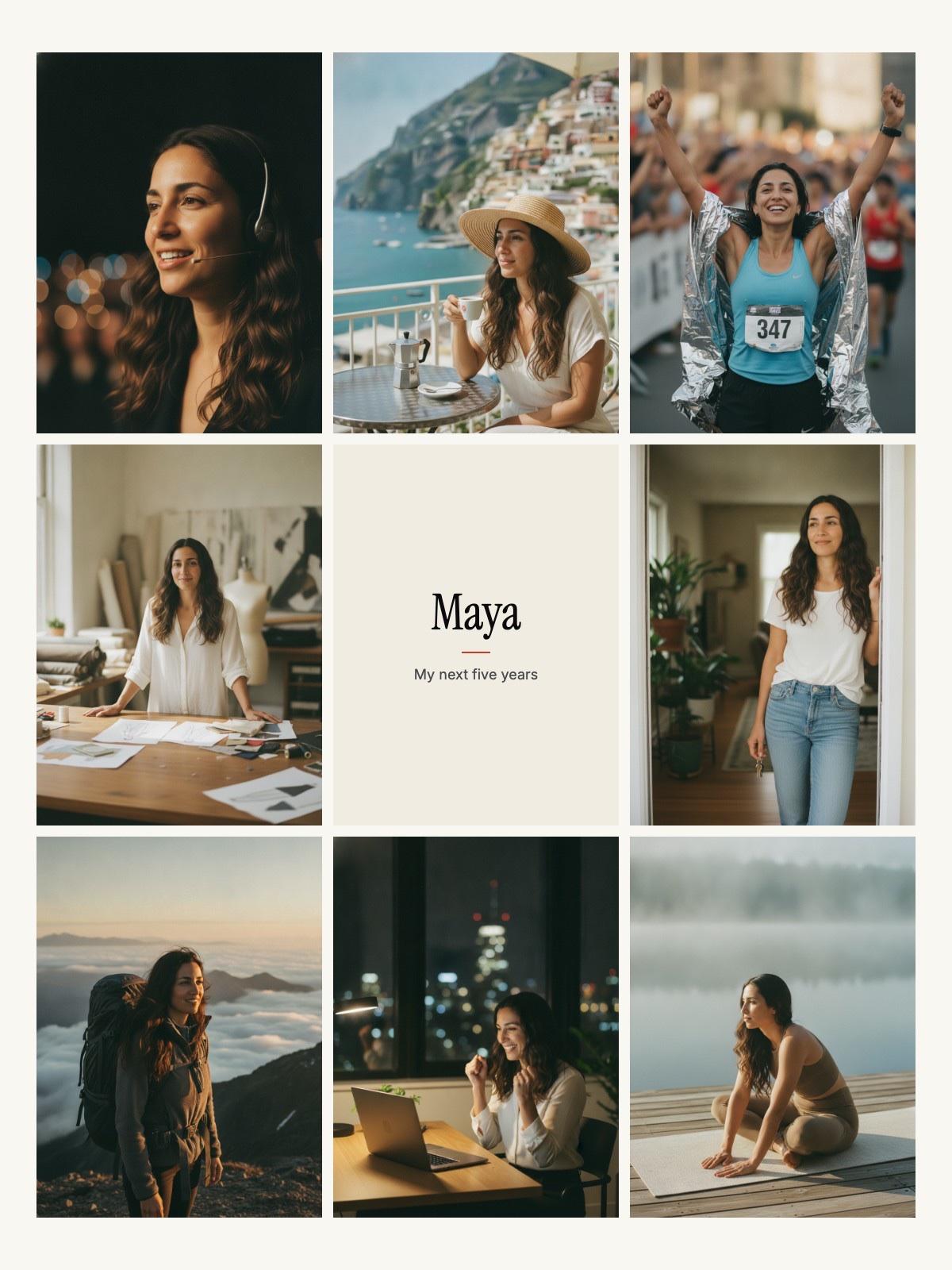
The picture sentence at the end of each entry is the part you can see. On /see-your-future-self you upload one photo and get the scene with your own face in it. The first scene is free, and the full board of eight scenes is $4.90 once, with nothing that renews. Set it as your lock screen and the entry is in front of you every time you pick up your phone.
Frequently asked questions
helpWhat is future self journaling?
Writing a few lines as, or to, the person you want to be in one, five or ten years, usually for about five minutes, and ending each entry with one small step for today.
helpHow often should I do it?
Daily works if it stays short. If daily feels like a chore, do it once a week on the same day. Coming back to it matters more than writing a lot at once.
helpShould I write in the present or the future tense?
Either works. The present tense, written as the future self ("I live by the sea"), puts you inside the scene. Use the one that feels natural to you.
helpWhat is the difference between a future self journal and a letter to my future self?
A journal is a habit of short entries. A letter is one longer piece you write once and open later. You can do both: a letter for the year, a short journal entry each week.
helpCan I use these prompts for a vision board?
Yes. The last prompt in each group asks for the picture of the answer. Those sentences are the scenes for your board.