The Best Possible Self Exercise: How to Do It, Examples, and What the Research Shows
Write the future you want, then make it something you can see.

The Best Possible Self exercise is a short writing practice: you imagine your life a few years from now, as if everything has gone as well as it reasonably could, and you write it down in detail. In the best-known early study, people wrote for 20 minutes a day on four days in a row. A common version today is 15 minutes a day. Research links it to better mood and more optimism. It is a way to get clear on what you want, not a promise that it happens.
What the Best Possible Self exercise is
Most future self practices ask you to imagine. This one asks you to write. You pick a point in the future, often a few years out, and describe the life you would have if your hard work paid off and things went well: where you live, what your days look like, who is around you, what you finally finished. You write about it as a real life, not as a wish list.
The best-known early study is a 2001 paper by psychologist Laura King in Personality and Social Psychology Bulletin. Eighty-one undergraduates wrote for 20 minutes a day on four consecutive days, each assigned to one of four topics. Those who wrote about their best possible future self found it less upsetting than writing about a hard past event, and their sense of well-being went up.
How to do it, step by step
Pick a time and a horizon
Set a timer for 15 or 20 minutes. Choose how far ahead you are writing: one year, three years or five. Pick one and stay there.
Imagine it went well
Picture your life at that point as if you worked hard and things went as well as they reasonably could. Not a lottery win: your own effort, paying off.
Write without stopping
Write in full sentences until the timer ends. Spelling and grammar do not matter. If you get stuck, describe an ordinary day in that life, from the morning on.
Cover a few areas
Work, health, relationships, home, the thing you do for fun. Two or three areas written clearly beat ten in one line each.
Be specific
Name the room, the city, the people, the project. "I am happy at work" gives you nothing to look at. "I run the Monday team meeting I used to dread" does.
Read it back and mark one line
When the timer ends, read the page once. Underline the one sentence that pulls at you most. You will use it in the last step below.
Three short examples
Each one names a place, a time and a detail you could picture. Yours will sound like you.
Career, three years out: "I lead a small team now. On Tuesday I gave the update to the whole company and my voice did not shake. I leave by six most days, and when a project ships I take the Friday off."
Health, one year out: "I run three mornings a week before work. In June I finished my first 10K, slowly, and I was smiling at the line. I sleep before midnight and I do not need coffee to start the day."
Relationships, five years out: "We have Sunday dinner at our place, phones in a bowl by the door. My sister and I talk every week now. I am the friend who remembers birthdays, because I put them in my calendar."

How long and how often
There is no single official schedule. King's 2001 study used 20 minutes a day for four days in a row. The Greater Good Science Center at UC Berkeley describes a version of 15 minutes a day for two weeks. Across the studies pooled in a 2019 meta-analysis, programs lasted from 1 to 56 days and from 20 to 170 minutes of practice in total, and there was a weak trend toward shorter total practice working at least as well. A good start: one session of 15 to 20 minutes, then repeat it on the days you want to come back to it.
What the research shows, and what it does not
A 2019 meta-analysis by Carrillo and colleagues in PLOS One pooled 29 studies with 2,909 participants. Compared with control tasks, the exercise improved positive mood (d = 0.51), optimism (d = 0.33) and well-being (d = 0.33), with a smaller effect on negative mood (d = 0.19). In about half of the studies, people also spent around five minutes picturing what they wrote.
The same authors are clear about the limits. Most participants were university students, no study met all of their quality criteria, and only three studies followed people for longer than three months. So the evidence supports the exercise as a lift in mood and outlook. It does not show that writing a future makes it come true. If you have asked yourself "why didn't it come true?" after a practice like this, that is the gap: the page gives you direction, and the next step still has to be taken.
The honest version
Writing your best possible self tends to leave people feeling better and more hopeful. What changes your life is what you do the week after.
From words to a picture you see every day
Most guides stop when the timer ends. The page goes in a drawer and the feeling fades. Two small steps keep it in front of you.
Turn three sentences into three scenes
Take the underlined line and two others, and picture each as one moment: where you are, what you wear, who is there. If you find it hard to see images in your head, make them outside your head instead.
Write one action for this week
Under each scene, one step you can do in the next seven days. The 10K scene gets "run 20 minutes on Tuesday". Pham and Taylor (1999) found that picturing the process of getting there, not only the outcome, improved studying and grades.
Put the scenes where you look
Your phone lock screen, the wallpaper on your laptop, the wall by your desk. You will see it many times a day without trying.
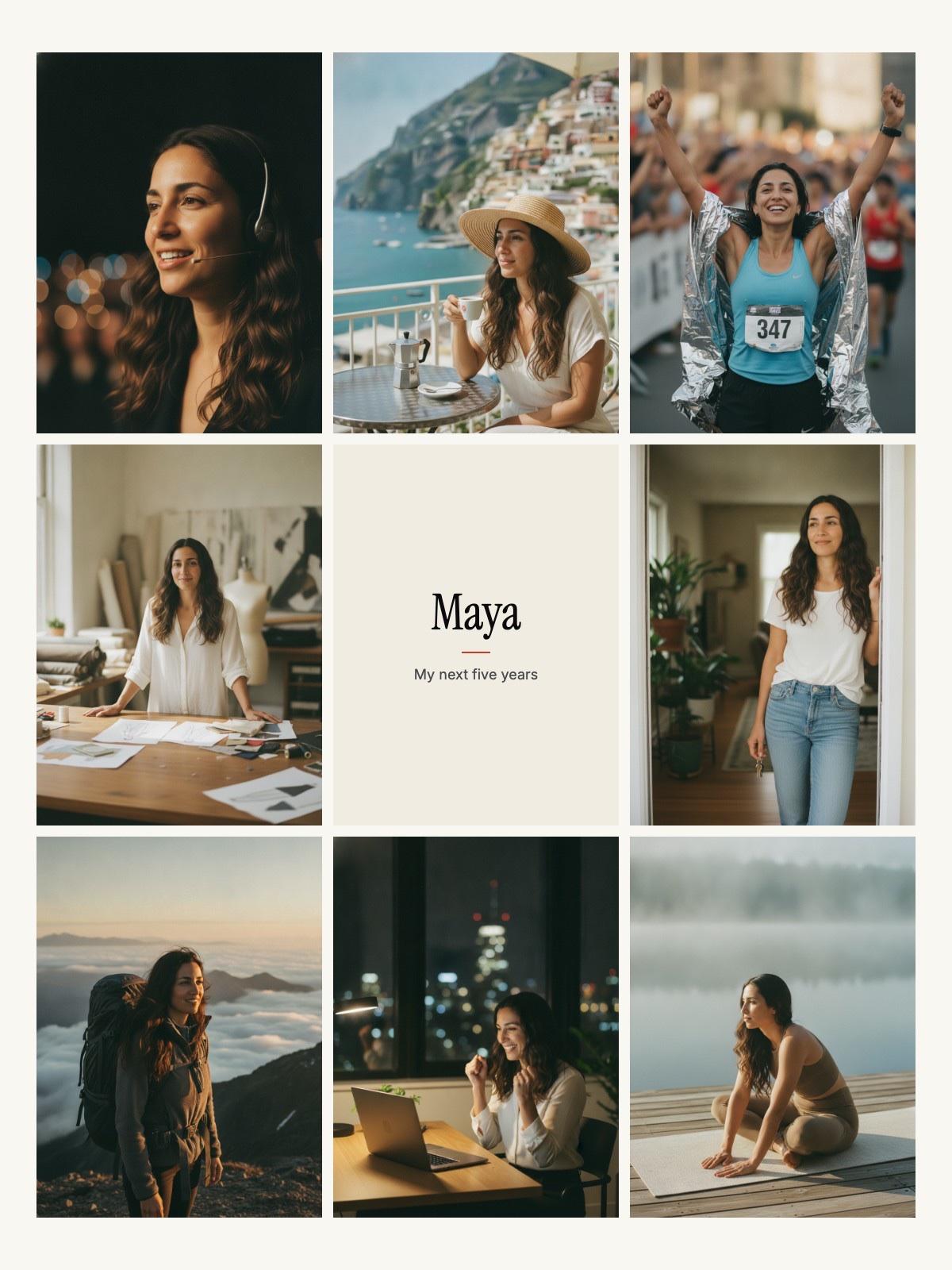
This is where FutureSelf fits. You upload one selfie and see your future self in the scenes you wrote, with your own face in them, so you meet your future self instead of straining to imagine her or him. The first scene is free with a free account; the full board of eight scenes is $4.90 once, with no subscription. Start here: /see-your-future-self
Who this is for
If you journal, script or do future self work and the future still feels like a stranger, or imagining it makes you a little sad that you are not there yet, this exercise gives you a clear page to start from. If you can picture the page but not the person, the scene step above is for you.
Best Possible Self vs a guided future self visualization
They are close relatives. The Best Possible Self exercise is written: you produce a page you can read again. A guided visualization is spoken or read aloud: you close your eyes and meet your future self in your mind. You can do both, on different days. If you want the spoken version, the full script with a 3-minute short version is at /future-self-visualization-script
Want more to write about? Prompts sorted by one, five and ten years ahead are in /blog/future-self-journaling-prompts, and if you would rather write to your future self than about them, see /letter-to-your-future-self
Frequently asked questions
helpHow long should I write for?
Fifteen to twenty minutes is the usual range. King's 2001 study used 20 minutes a day for four days in a row; the Greater Good Science Center version runs 15 minutes a day for two weeks.
helpHow often should I do the Best Possible Self exercise?
Studies lasted from a single day to eight weeks, and there is no proven best schedule. Write once, then come back to it when you want the direction again, and look at the scenes you made from it every day.
helpIs there a Best Possible Self worksheet?
The six steps on this page are the worksheet: a timer, a time horizon, three areas, specific details and one underlined line. Copy them into a notebook or a note on your phone.
helpWhat is the difference between the Best Possible Self exercise and visualization?
The Best Possible Self exercise is mainly writing. Visualization is picturing. In about half of the studies people did both: they wrote, then spent a few minutes picturing what they wrote.
helpDoes the Best Possible Self exercise make the future happen?
No study shows that. The research shows better mood and more optimism, mostly in students and over short periods. Pair the page with one action a week.