



Quick Answer
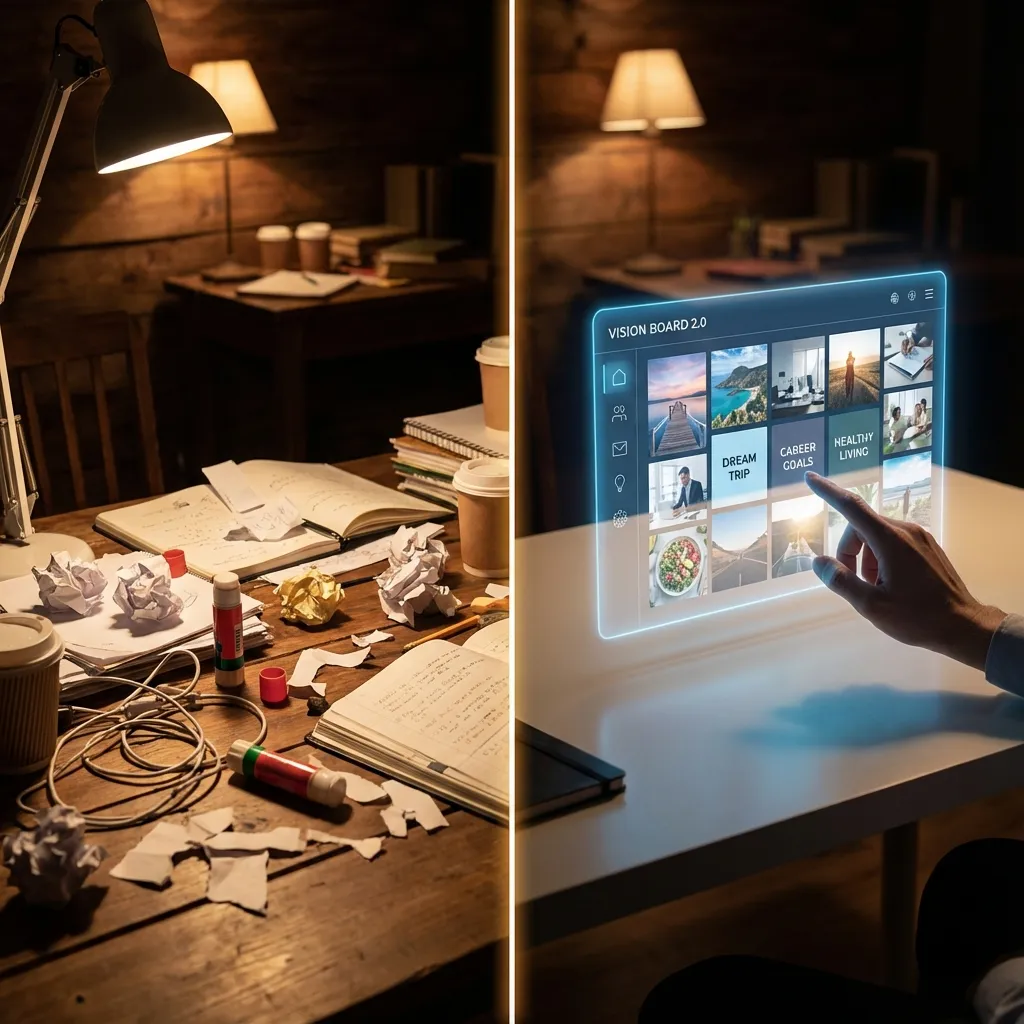
AI vision boards are generally more effective because they use neural personalization (showing YOUR face in success scenarios) to create stronger brain pathways. However, traditional boards are better for tactile learners who enjoy the physical craft process.
Vision boards have been a staple of personal development for decades. From Oprah to Olympic athletes, successful people swear by the power of visualization. But with the rise of AI image generation, there's a new player in the manifestation game.
In this article, we'll compare traditional vision boards with AI-powered alternatives to help you choose the method that's most likely to help you achieve your goals.
Quick Comparison
The Neuroscience of Self-Recognition
Here's where AI vision boards have a significant advantage. Kelley et al. (2002), in the Journal of Cognitive Neuroscience, found that judging whether a trait applies to you engages a distinct region of medial prefrontal cortex that judging it of someone else does not. When you see your own face, your brain activates differently than when viewing strangers.
Studies show that self-referential processing (seeing yourself) activates the medial prefrontal cortex, which is directly linked to goal-directed behavior and motivation. See Nature Human Behaviour.
This means when you see yourself (not a model) achieving your goals, your brain processes it as more personally relevant and attainable. It's not just a goal-it's YOUR future.
Alternative Tools Comparison
There are many ways to create vision boards. Pinterest is great for inspiration and collecting images. Canva offers beautiful templates. Apps like Subliminal360 focus on affirmations. But none of these can generate photorealistic images of YOU in your future scenarios.
When Traditional Vision Boards Win
Traditional vision boards aren't without merit. Here's where they excel:
- check_circleTactile Experience: The physical act of cutting, arranging, and gluing can be meditative and therapeutic
- check_circleGroup Activity: Great for vision board parties and workshops
- check_circleNo Tech Required: Accessible to anyone with magazines and scissors
When AI Vision Boards Win
- auto_awesomePersonal Identity: See YOUR face achieving YOUR specific goals
- auto_awesomeSpecificity: AI can generate exactly what you describe, not limited by magazine inventory
- auto_awesomeQuality: Photorealistic images that look like actual photographs of your future
- auto_awesomeConvenience: Digital delivery means instant access on all devices
The Verdict
If you enjoy the creative process and want a group activity, traditional vision boards are great. But if you want maximum psychological impact and seeing yourself in your future is important to you, AI-powered vision boards have a clear edge.
The best approach? Use both. Create a traditional board for the experience, and an AI board for your phone wallpaper where you'll see it many times a day.
Frequently Asked Questions
Are digital vision boards as good as physical ones?
Yes, often better due to frequency of exposure. A digital board on your phone is seen every time you unlock it, whereas a physical board is often ignored after a few weeks.
Can I print my AI vision board?
Absolutely. FutureSelf.ai provides high-resolution downloads suitable for printing, so you can have the best of both worlds: personalized AI imagery in a physical format.
Try AI Vision Boards for Yourself
See your face in 8 hyper-realistic future scenarios. Generated in minutes, not hours.
Create Your AI Vision Board